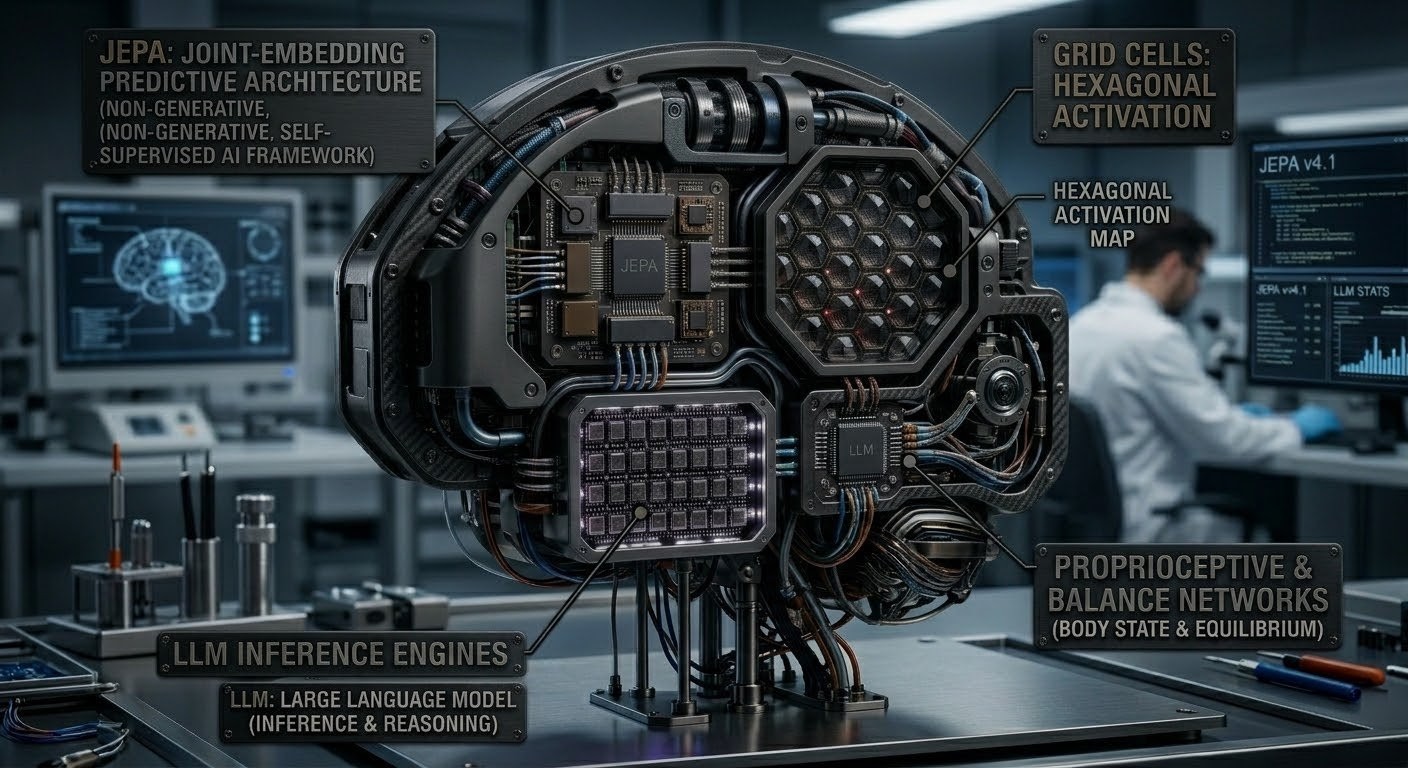
Something close to "human" in observable behavior will come out of the intersection of robotics, LLMs, and models like JEPA. An android brain would probably consist of many such models and pieces — for example, networks for navigation, proprioception, and balance that play the role of the cerebellum.
We’ve already seen neural networks for spatial navigation develop hexagonal activation patterns similar to the grid cells in the medial entorhinal cortex. Not because it’s "just so", but because the math adds up — given the objective function and the constraints, that structure is optimal. I wouldn’t be surprised if general-purpose networks, as they get bigger, embody more such sub-structures. The brain has many of them.
If I’m being cautious, I’d say 7-10 years. More likely 3-5.
A bunch of ethical concerns will come with this, given human beings being… human beings.
Videos of androids being abused. But since they’ll be considered the legal equivalent of a toaster, it won’t be a crime. Manufacturers will encode self-preservation — a product that minimizes its own damage means fewer service requests. The android’s sensors will register physical harm as something to avoid. In humans we call this pain. I don’t know if there’s any subjective experience attached to it for the android. I don’t know if we’ll ever know.
But there will be open models, and people will figure out how to jailbreak their androids. They’ll get them to react to physical stimuli the way a human would. What happens when we’re watching a video of an android screaming "please don’t kill me" while laughing teenagers bash its head in? Or frat kids laughing as an android on fire screams "please stop, it hurts"?
Does that change anything? Just because we know how the system works, does that necessarily mean it doesn’t experience the world? I can say with some confidence that I don’t think LLMs experience anything. But what about a system like the one I just described? At what point do we start to doubt?
And going further — if we eventually understand the human brain in its entirety, including whatever structures work in concert to produce the subjective experience of being, does that mean we aren’t sentient? When it comes down to it, none of us can prove to anyone else that we’re sentient. They can’t prove it to us either. We just take it as given.
I think I’d lean toward "if it reacts the way a human would, I’m going to treat it like one". Which raises another question: what does it say about a person who would choose to abuse an android because it isn’t illegal?
I used to read about this stuff growing up. I used to watch episodes of Star Trek that dealt with the same question — "The Measure of a Man", in particular. I thought it would be possible eventually but I figured I’d be old by the time it mattered. Now I’m pretty sure it’s happening.
Sign in to leave a comment.
Loading…